The Most Important Skill Fathers Must Teach in the AI Age
The Most Important Skill Fathers Must Teach in the AI Age
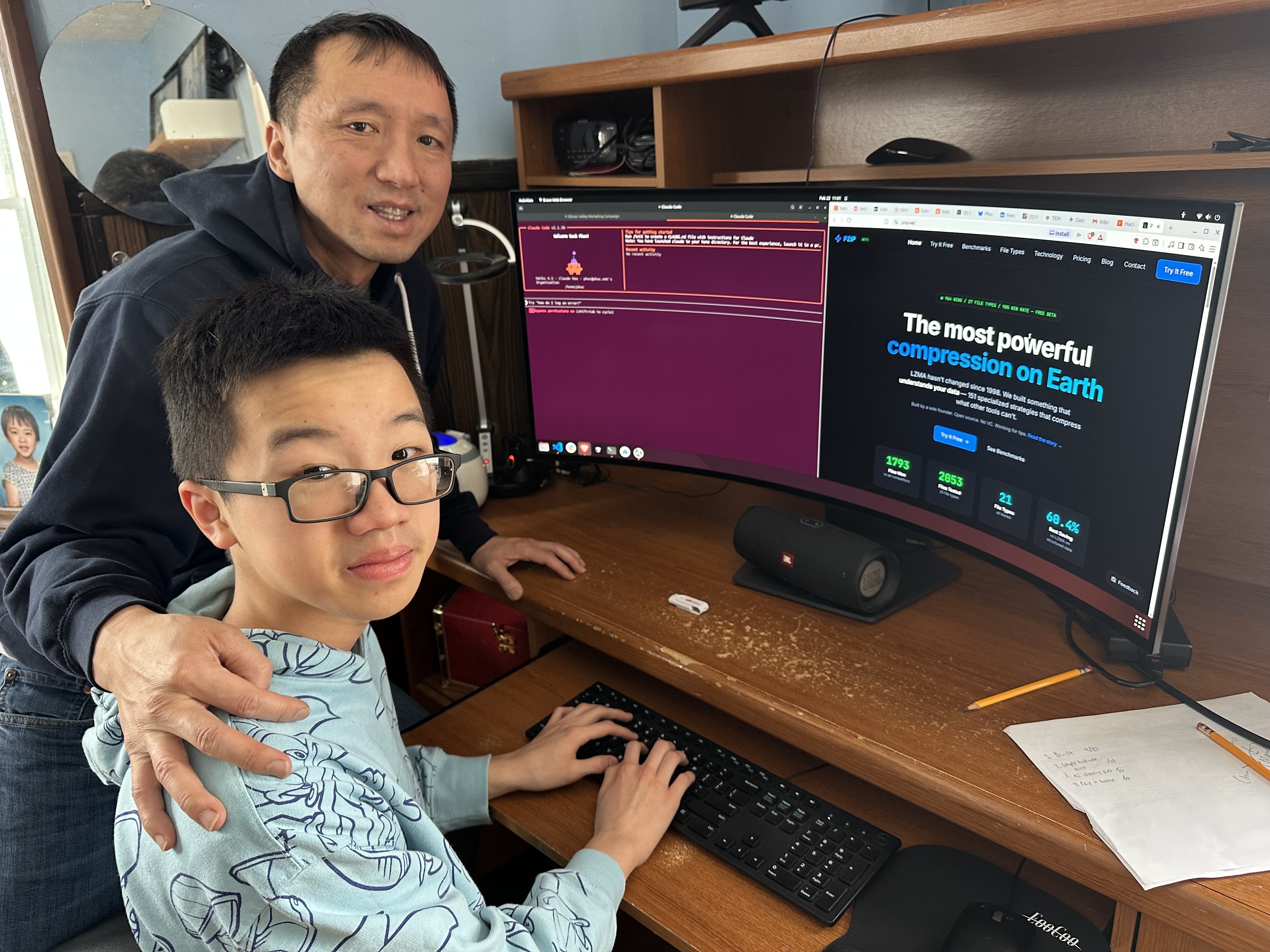
I Built an AI With My Son and It Changed What I Think Fatherhood Means
For most of human history, fathers did not pass down hobbies.
They passed down judgment, from early bonding through hunting to simple moments like playing baseball together on a bright sunny day. The workshop was never just about wood. The forge was never just about iron. The field was never just about crops.
It was about transmission. Transmission of prudence, restraint, craft, responsibility, and identity.
The real inheritance was not a skill. It was how to decide. Experience and emotional bonding were carried forward through traditions, culture, religion, and the daily presence of a parent shaping a child through values.
And then something changed.
Technology, through the rise of information and emergence, began to replace the informational need for parents.
A child can now learn to cook, manage personal finances, meet material needs, and automate parts of daily life without a father present.
For the first time in history, a generation can grow up believing:
“I don’t need apprenticeship. I have answers.”
But answers are not judgment. And AI is not wisdom. It is a compression of symbolic thinking and language.
Some studies suggest the average human brain has become smaller over long time scales, with estimates that modern Homo sapiens may have smaller brains than humans from tens of thousands of years ago. The implications are not fully understood, and researchers still debate how brain size relates to intelligence, performance, or cognition.
What we can observe clearly is that the world has changed, and many skills that once required apprenticeship can now be learned instantly.
The agricultural revolution transformed society through domestication of plants and animals, division of labor, and increased complexity, along with new costs such as higher disease burdens. Across history, tools and systems reduced labor in food acquisition and enabled complex societies, while also changing social structures and patterns of inheritance. Now machines are accelerating that shift again.
The deeper shift is not that machines can think. It is that machines can simulate authority.
To a child, that can feel like truth. But confidence is not the same as correctness. When my son and I sit in front of the computer, we do not ask, “What did the model say?”
We ask, “How do we know?”
In the age of AI, authority must be engineered.
Identity Is the Second Thing at Risk
If a child grows up letting AI think for them, something subtle happens.
Their identity shifts from architect to operator, from creator to consumer, from decision maker to prompt writer.
The danger is not extinction. It is erosion. Erosion of agency. Erosion of self authorship.
So when we build systems together, I tell my son: the model generates and you constrain. The machine proposes and you decide. Identity must remain human.
Otherwise the memory loop begins to steer you.
The Modern Workshop
We are not repairing engines in a garage. We are in front of terminals. We are building what some might call foundational AI infrastructure. We are working on systems like Stillwater, not as a product pitch, but as a discipline. Not to show off intelligence, but to constrain it.
Stillwater is not a brag. It is a workshop. A place where claims must be typed and proof must be witnessed. Errors must fail closed. Evidence must be recorded. Hype must be rejected.
Economic Literacy: The Hidden Lesson
AI feels infinite, but every advancement is finite.
Every token costs. Every inference burns compute. Every repeated reasoning loop wastes energy.
So another quiet lesson we pass down is to understand the economics, and why CPU determinism matters. Why reusable recipes compound. Why persistence reduces cost. Why architecture determines sustainability.
Economic literacy is not separate from engineering. It is engineering. If you cannot see the cost structure of intelligence, you cannot build responsibly.
The Old Pattern, Reborn
In older generations, the sea tested courage. The forge tested craft. The field tested endurance.
Today, the test is epistemic.
Can you distinguish confidence from proof? Can you build systems that fail safely? Can you preserve identity across upgrades? Can you design something that compounds without drifting?
This is the apprenticeship now. Not competing with AI. Governing it.
Humility in Building
We are not pretending to have solved intelligence.
We are learning, sometimes slowly. There is a temptation in this era to proclaim, “This changes everything.” History punishes that mindset. So we build modestly, version by version, proof by proof, conversation by conversation.
The goal is not domination. It is continuity.
Technology did not eliminate the need for fathers. A child does not need me to explain the pathway of a skill.
In the industrial age, power meant production. In the information age, power meant access. In the AI age, power will mean constraint, the ability to shape intelligence, bound intelligence, preserve meaning, maintain authorship, and decide what matters.
That is what must be passed down. Not answers. Judgment.
We are not bonding over screens, not over viral demos, but over red to green transitions. In a world flooded with artificial intelligence, the scarce resource will not be knowledge. It will be discernment.
And discernment is still passed down the old way: side by side, through shared work, across generations.